

Which Passive Income Streams Are Actually Worth It for Artists
A listener asked the question almost every working artist has wondered at some point: which passive income streams are worth the setup time and cost?
Megan Daisy Milner and I recently sat down for a podcast episode where we answered listener questions, and this one stayed with me. Because the honest answer starts with something slightly annoying but very freeing.
Nothing is actually passive.
Every income stream takes real work to set up. It takes real work to maintain. It takes real decision-making to figure out whether the return is worth the time, money, storage space, vendor emails, customer service, and brain space.
The internet loves to sell the dream that you can build something once and wake up to sales forever. That dream is why plenty of artists have paid $100 for a digital download bundle, an Etsy-get-rich-fast course, or a “sell while you sleep” template that brought in exactly $0 last year.
So instead of pretending there is one magic option, let’s talk about what actually works, what costs more than people admit, and which streams can make sense for artists who already have a body of work and an audience.

The better question is whether the work compounds
When people ask about passive income for artists, they often mean, “What can I sell without making a brand-new original every time?”
That is a better way to think about it.
A so-called passive income stream is usually something that lets work you have already made keep earning. That might be a print of an original painting, a digital guide, a licensed image, or a product made with a manufacturer.
But none of those are hands-off. They are just different from commission work or selling one original at a time.
A good creative passive income stream has a few things in common:
The setup work can be used again and again.
The product does not require your constant personal involvement.
The profit margin makes sense after production, packaging, platform fees, and taxes.
The offer does not weaken the value of your higher-priced work.
The customer understands what they are buying without a long explanation.
That last one matters more than people think. If someone lands on your shop and cannot tell the difference between an original, a print, a study, a textile, and a digital download, the “passive” product starts costing you sales instead of adding them.
Prints are worth considering if your originals can support them
Megan is passionate about prints, and she has put real thought into making them feel premium rather than like a cheap add-on to her originals.
She uses a specific photographer in Charlotte to capture her work properly. She has gone through multiple vendors to get samples that actually match what she wants. That is the part people skip when they talk about prints.
Prints are not just “upload a photo and let it go.”
Good prints require:
Strong photography or scanning
Color matching
Test prints
Paper decisions
Size decisions
Packaging
Shipping materials
A fulfillment process
Clear product descriptions
A plan for damaged packages and customer issues
Megan’s honest take was that prints can be worth it, but getting them set up properly takes a significant amount of work. I would add that it can also take a significant amount of money.
Once the system is running, prints can become more hands-off than originals. You can reorder inventory. You can work with a printer. You can batch packaging. You can offer a few sizes instead of reinventing the wheel every week.
But you are not skipping the upfront investment.
The bigger issue is pricing. Prints only work if your originals are priced high enough that the two are not competing with each other.
If your original is $200 and your print is $55, you may be accidentally teaching people that the original is not worth much more than a reproduction. The print should feel like an accessible entry point into your work, not the same thing at a discount.
A print makes sense when:
Your originals sell at a clearly higher price point.
You have images people already respond to.
You can make the print feel intentional and high quality.
You are willing to spend time testing vendors.
You have enough audience demand to justify the setup.
Prints are probably not the first place I would start if you are still struggling to sell originals consistently. They work best when there is already some demand to capture.
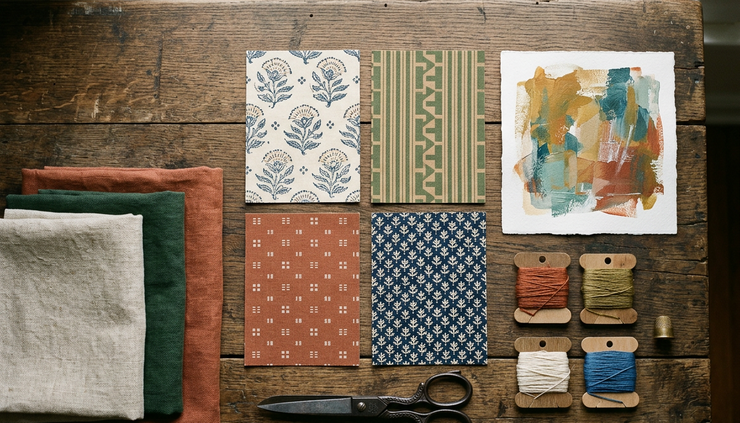
Textiles are beautiful, but they are not the easy version of prints
Megan has a textile background from NC State, so I paid attention when she talked about this. Even with that background, she said textiles are ten times the work of prints.
That sounds dramatic until you think through what textiles involve.
With prints, you are usually trying to reproduce an image as accurately as possible on paper. With textiles, you are translating artwork into a totally different object. Fabric moves. Dye behaves differently. Scale changes everything. A painting that looks beautiful on canvas may not automatically work on a scarf, pillow, napkin, or yardage.
Textiles usually mean:
Higher upfront costs
More complex vendor relationships
Larger minimum order quantities
Longer sample timelines
More quality control
Storage space
More customer service questions
A stronger need for product photography
And once you have the product, you have to sell through inventory.
That is the part that makes textiles risky. A print can often be made in small batches, or even ordered as needed if your system allows for it. A textile product may require a larger order before you know whether your audience wants it.
That does not mean textiles are a bad idea. They can be incredible when they match the artist’s work and the customer’s life. A collector may not be ready to buy an original, but they might love living with your pattern on a scarf or table linen.
The question is whether the object truly makes sense for the art.
A textile line is worth exploring if you have:
Repeating patterns or work that translates well to fabric
A clear point of view beyond “my art on a thing”
Money available for sampling
A realistic plan for inventory
Access to vendors you trust
An audience that already buys home or lifestyle products
If you want the lowest-lift income stream, textiles are not it. They can be wonderful, but they are a product business. Treat them that way.
Digital products only work when they solve a real problem
Digital products are where the internet gets especially loud.
People will tell artists to sell Procreate brushes, templates, guides, tutorials, stock images, printable planners, color palettes, ebooks, or mini courses. Some of those can work. Many do not.
The reason is simple. A digital product is not valuable because it is digital. It is valuable because someone wants the result it helps them get.
A downloadable PDF that says “how to be creative” is probably not enough. A guide that helps a collector hang art in a tricky hallway might be genuinely useful. A template for artists to track inventory could sell if it solves a real pain point and is easy to use. A set of brushes might work if your audience already wants to make work in a style related to yours.
Digital products have real advantages:
No physical inventory
Low delivery cost
Easy updates
High margin after the setup
Simple fulfillment once the system works
But the hidden work is still there.
You have to write, design, test, describe, price, deliver, and support the product. You may need to update it when platforms change. You may need to answer questions from buyers. You may need to drive traffic to it over and over.
Digital products are best when they grow from something people already ask you for.
If people constantly ask how you organize your studio inventory, a simple spreadsheet might make sense. If collectors ask how to choose frame sizes, a framing guide could work. If other artists ask about your color mixing process, a paid workshop or recorded lesson might be useful.
If no one has asked for it, pause before spending three weeks building it.
That is where many passive income streams for creatives go sideways. The artist starts with the product instead of the demand. Then the product sits there, beautifully designed and completely ignored.
Licensing can be powerful, but it is not instant money
Licensing is one of the income streams that can sound the most passive. Someone pays to use your artwork on a product, in a publication, or as part of a collection. You get paid without producing a new original for every sale.
That can be great.
But licensing takes its own kind of work. You need organized files, clear rights, strong contracts, and a sense of where your work fits. You may need to pitch. You may need to negotiate. You may need to say no when the terms are bad.
For artists, licensing can make sense when the work has a clear commercial use. Patterns, florals, seasonal artwork, food illustrations, coastal scenes, botanical work, and strong repeatable motifs often translate well. That does not mean every artist needs to make that kind of work. It just means licensing has practical realities.
Before you license anything, know what you are agreeing to:
Where the image can be used
How long the company can use it
Whether the agreement is exclusive
What products it can appear on
How you get paid
When payment happens
Whether you can still sell the original or prints
A large licensing deal can be meaningful. A small one with messy terms can create problems for years.
This is one of the few places where paying for legal help may be worth it, especially before signing a contract with broad rights. The point is not to be scared. The point is to understand that “passive” income can still require very active protection of your work.
Courses and memberships are usually less passive than they look
Courses can be wonderful if you like teaching. Memberships can be wonderful if you enjoy community and recurring content. But please do not confuse either one with passive income.
A course takes planning, recording, editing, platform setup, launch emails, student support, and updates. If the course depends on a platform or software, it may need regular revisions. If students get stuck, they may email you.
A membership is even more active. Recurring revenue sounds great, but recurring value is the other side of it. Members need a reason to stay. That might mean monthly lessons, critiques, prompts, live calls, or new resources.
That is not bad. It is just not passive.
A course might be worth it if:
You already teach the topic often.
You can clearly explain the outcome.
The material does not become outdated quickly.
You have an audience that trusts you.
You are willing to support students.
A membership might be worth it if you like showing up on a schedule. If you resent ongoing obligations, choose something else.
What I would track before deciding what worked
When I look at my own so-called passive income over the past 90 days, I do not just look at revenue. Revenue is the internet screenshot. Profit is the number that matters.
And even profit is not the whole story.
The real review is:
Income stream | What to measure |
Prints | Profit after printing, packaging, shipping supplies, damaged orders, and platform fees |
Textiles | Profit after samples, bulk orders, storage, photography, and unsold inventory |
Digital products | Profit after platform fees, design time, updates, and customer support |
Licensing | Payment after contract review, negotiation time, and usage limits |
Courses | Profit after software, editing, launch time, and student support |
Memberships | Monthly recurring revenue minus the cost of showing up every month |
If I made $1,000 from a product but spent 40 hours setting it up and $700 producing it, that is a very different result than making $300 from something that took two hours to maintain.
This is why I recommend looking at the last 90 days instead of trying to judge everything emotionally.
Ask:
What sold without a lot of explanation?
What created the most customer service?
What had the highest profit margin?
What supported the value of my main work?
What made me proud to sell?
What was annoying every single time someone bought it?
That last question is underrated. If you dread fulfilling an order, the income stream may not fit your life, even if it technically makes money.
The income streams I think are most worth it
If I had to rank these for most artists, I would start here.
Prints are the strongest first option for many visual artists. They can support the world of your originals when they are priced and produced well. They are not easy, but they are understandable to buyers.
Digital products are worth it when they answer repeated questions. Do not make random downloads because someone online said they are scalable. Make them because there is a specific person with a specific problem.
Licensing is worth learning about if your work fits products or publications. It may take longer to develop, but it can pay well when you protect your rights.
Textiles are worth it only if you are ready for a real product line. They are not a casual add-on. They require taste, patience, money, and a willingness to deal with production.
Courses and memberships are worth it if you actually want to teach. If you do not enjoy teaching, they will feel like a trap with a checkout page.
The worst option is the one you choose because someone else made it sound easy.
The best option is the one that fits your art, your audience, your price points, your energy, and your willingness to maintain it after the exciting setup phase is over.
The real test is whether the stream supports your work
Passive income is not magic money. It is a system.
Sometimes that system is worth building. Sometimes it becomes a distraction from the work that actually pays you well. The goal is not to add every possible income stream. The goal is to build the few that make sense.
For artists, the most useful question is not “What can I sell while I sleep?”
The better question is, “What can I build once, maintain honestly, and sell in a way that strengthens the rest of my work?”
If the answer is prints, make them beautiful. If it is textiles, treat them like a serious product. If it is a digital guide, make it genuinely useful. If it is licensing, protect your rights. If it is teaching, show up like a teacher.
Nothing is actually passive. But the right income stream can still give your work a longer life, and that is worth paying attention to.


Comments